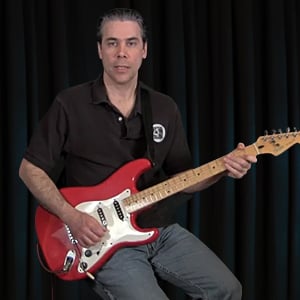
Christopher Schlegel
Christopher was born in St. Louis, Missouri,
in 1966. Hearing the music of Tchaikovsky at age 5, he responded by building a
makeshift podium in his room and pretending to conduct. A year later, after
getting a Monkees LP and the Mary Poppins soundtrack, he proceeded to make a
guitar of sorts out of a yardstick, shoebox top, and some twine and rubber
bands.
These inventive beginnings have led to a life long career in music, and
Christopher has been playing guitar for over 30 years now. In his teen years,
Christopher started playing in cover bands doing material by The Ramones,
Kiss, and Jimi Hendrix, and he soon branched out into jazz, blues, and other
areas of rock. In his late 20s he stopped playing in bands regularly, to focus
on serious composition.
Self-taught up to that point, he began to study music privately, later
entering Bethel College and acquiring a BA in Music with an emphasis in
Applied Guitar. During that period Christopher focused on developing a high
level of skill in the classical and jazz genres, as well as furthering his
knowledge and abilities in rock, pop, and fusion styles.
Christopher has over 20 years of private instruction experience teaching
guitar and music theory to students of all ages and all styles. His love of
many different styles of music enables him to apply the basic fundamental,
unifying principles of music to any genre. In addition, he teaches classes and
seminars involving music technology (MIDI sequencing, digital recording,
scoring), and composes and performs his original music.
For more personal information from Christopher himself, go to the "More
Instructor Info" page below. You can also post any questions or comments
directly to him in his personal forum, using the Message button to the left.
Simple C Major Chord
In this lesson we are going to learn a simple C major chord. Some of the notes are "open" string notes. In this case, make sure to keep your fingers clear of that string so you don't mute it. You want to have your hand "hovering" or "arched" slightly over any string that has an "open" string note. Some of the notes are "fretted" notes. In this case, place the tip of the your index finger right behind the first fret of the B string (the second thinnest one). It is important to use the tip of your finger. Beginners find their fingers can be tender & occ...
Note Names on the 1st String
Sometimes it's difficult for beginner's to see, but there is a reason for the placement of the note letters on the guitar fretboard. We will take a more in depth look at those reasons later on. For now, we will just learn the location of the notes. The first notes to learn are the notes of the open strings. The strings of the guitar are named for the note letter that sounds when those strings are played open. Starting from the highest sounding string pitchwise (the thinnest string) and moving to the lowest sounding string (the thickest string), these are the note...
Simple A Minor Chord
In this lesson we are going to learn a simple A Minor chord. This is the first chord where you will need to use two fingers at the same time. Some of the notes are "open" string notes. In this case, make sure to keep your fingers clear of that string so you don't mute it. You want to have your hand "hovering" or "arched" slightly over any string that has an "open" string note. Some of the notes are "fretted" notes. In this case, we need to use two fingers: index and middle fingers. Place the tip of your index finger right behind the first fret of th...
Intervals for Beginners Lesson 1
What are intervals? In music the basic unit of measurement is the interval. An interval is the distance between any two notes. Intervals are measured in "steps". Most instruments are divided into half step divisions. On a piano the musical distance from one key to the next adjacent key is one half step. On a guitar the musical distance from the note on one fret to the note that sounds on the next fret (up or down) is one half step. More simply, the distance from one fret to the next fret is a half-step. The distance between two frets is a whole-s...
Right Hand Technique for Beginners Lesson 1
What does the right hand do? The primary job of your right hand is to strike the strings. This is usually done by picking or strumming with a pick (also called a "plectrum") or the right hand fingers; or a combination of both a pick and fingers which is called hybrid picking. The right hand also has the secondary job of muting strings; in other words, to stop certain strings from ringing when you don't want them ring.
Another Melody on the Upper Strings
Now we have a little experience playing notes on the E & B strings. Let's play another, slightly more complicated melody on these strings. This is the traditional tune "My Country 'Tis of Thee". As with all our melodies so far, go slowly, take your time. Learn where to put your fingers to play the notes properly. Gradually memorize the notes in order. Gradually get better at placing your fingers for the best possible sound out of each note. Practice and have fun.
How Notes Are Named (Introducing A-G Terminology)
In music we use the first 7 letters of the English alphabet in order to name, identify and organize individual notes: A, B, C, D, E, F, G. Then we start again at A. As the old music al joke goes, "There is no letter H in music." So we wind up with the pattern: A, B, C, D, E, F, G, A, B, C, D, E, F, G, A, B ... and so on covering the entire guitar fretboard. As the notes move through the alphabet the pitch rises from lower to higher. In the next set of lessons we will learn where these notes are on the guitar. The image below is for your future referen...
The Mechanics of Fretting Notes Lesson 1
This tutorial explores the mechanics of playing the guitar in more detail; this covers the physical motions required of your arms, hands and fingers. There are two fundamentally different types of notes on the guitar: open string notes and fretted string notes. Open string notes are indicated on tablature notation by the number zero "0" on the appropriate string. In this case, make sure to keep your fretting hand clear of the string so you don't mute it. You want to have your hand hovering or arched slightly over the string prepared to pla...
Simple G Major Chord
In this lesson we are going to learn a simple G major chord. Some of the notes are "open" string notes. In this case, make sure to keep your fingers clear of that string so you don't mute it. You want to have your hand "hovering" or "arched" slightly over any string that has an "open" string note. Some of the notes are "fretted" notes. In this case, place the tip of the your pinky finger right behind the third fret of the E string (the thinnest one). It is important to use the tip of your finger. Beginners find their fingers can be tender & occassiona...
C Major Scale for Beginners Lesson 1
What is the C major scale? A scale is a very specific pattern of notes that is used to create the basic building blocks of music: melody and harmony. In order to build a scale from the intervals of the octave we need a formula. The major scale formula is derived from the nature of the overtone series and is: 1st note, whole step, 2nd note, whole step, 3rd note, half step, 4th note, whole step, 5th note, whole step, 6th note, whole step, 7th note, half step, 8th note (which is one octave higher than the first note). This formula produ...
Note Names on the 2nd String
Now we are on the 2nd string, the B string. As we've already learned, the note that sounds when we play the B string open (at the "zero fret") is called B. If we hold down the B string at the first fret, we make the amount of string allowed to ring a little bit shorter and thus a little bit higher in pitch. It is now called the note C. If we hold down the B string at the third fret, we make the amount of string allowed to ring a bit shorter again and thus a bit higher in pitch. It is now called the note D. We do this one more time by h...
Simple Chords Group 1 & 2 Summary
This is a brief summary of what we have covered in the last two tutorials. Having learned the basic mechanics of fretting notes, we learned how to play four simple chords (C major, G major, A minor and E major). We learned how to play them individually and then put some of them together.
Practicing Simple C and G Major Chords
Now that we have our simple C major chord and G major chord, let's put them together! In this lesson we will practice strumming them and going back and forth between the two. Start with the C major chord. Get your fingers in position. Strum it three times downward. Stop the strings (mute!) from ringing. Change your fingers to the G major chord position. Strum it three times downward. Stop the strings (mute!) from ringing. Change your fingers back to the C major chord position. Repeat this over and again. Congratulations! You are playing music!
Tips on Learning and Practicing Music
When we are presented with a new piece of music for the first time it can be difficult and frustrating. The best thing to do is to break the process down into two separate steps: First, learn the notes. This means learn where all the notes are in the song. Figure out where you will have to put your fingers ahead of time. Look over the whole piece to get a bird's eye view of the whole thing. If you are a beginner, don't expect to be able to play the whole thing all the way through immediately! Most important in this first step of the process is to fig...
A Melody on 1st and 2nd Strings
Now we know some of the musical alphabet note names on two strings! Let's put that knowledge to use and play a melody using those notes. This is a simple arrangement of the Christmas song "Jingle Bells". Go slowly, take your time. Learn where to put your fingers to play the notes properly. Gradually memorize the notes in order. Gradually get better at placing your fingers for the best possible sound out of each note. Practice, practice, practice! And have fun playing your first melody.
Note Names on the 3rd String
Now we are on the 3rd string, the G string. As we've already learned, the note that sounds when we play the G string open (at the "zero fret") is called G. If we hold down the G string at the 2nd fret, we make the amount of string allowed to ring a little bit shorter and thus a little bit higher in pitch. It is now called the note A. If we hold down the G string at the 4th fret, we make the amount of string allowed to ring a bit shorter again and thus a bit higher in pitch. It is now called the note B. With the 4th fret note B w...
Introducing the A Major Chord
Now we are ready to learn our first full chords for the guitar. This tutorial assumes your guitar is in tune and you have acquired the ability to play open string notes as well as fretted notes. In music, a Chord is defined as a group of three or more notes that are played together at the same time. We will start with learning the basic Open String Chords in the first position. These are called Open String Chords because they make use of as many open strings notes as possible. We will start with the most basic way to play a full A m...
Practicing Simple C Major and A Minor Chords
Now we have two more simple chords to put together! In this lesson we will practice strumming them and going back and forth between the C major and A Minor chords. The idea here is to get used to using the index finger position of the C major chord as an "anchor" to hold onto for one chord. Then adding the middle finger to the position for the A minor chord. Start with the C major chord. Get your fingers in position. Strum it three times downward. Stop the strings (mute!) from ringing. Reach over and add your middle finger for the A minor chord position. Strum...
Left Hand Technique for Beginners Lesson 1
What does the left hand do? The primary job of your left hand is to fret notes. This means you will use (mostly) your fingertips to apply enough pressure to the strings to hold them down against the frets in order to get a good, clear sounding note when you pick or strum the strings (with your right hand). Occassionally you will use the pads of your fingertips in order to fret more than one string at a time. You will also find it occassionally useful to use the entire length of a finger (usually your index finger) in order to barre across all or almost all t...
Summary of Knowledge and Skills GF 1 Chapter 3
Having viewed the lessons in this chapter on Introduction to Chords, you should have a basic understanding of the following things: The Mechanics of Fretting Notes. How to play simple versions of C major and G major chords. How to change back and forth between C and G major chords in time. How to play simple versions of A minor and E major chords. How to change back and forth between C major and A minor chords in time. How to change back and forth between A minor and E major chords in time. You can alwa...
Note Names on the 5th String
Now we are on the 5th string, the A string. As we've already learned, the note that sounds when we play the A string open (at the "zero fret") is called A. If we hold down the A string at the 2nd fret, we make the amount of string allowed to ring a little bit shorter and thus a little bit higher in pitch. It is now called the note B. If we hold down the A string at the 3rd fret, we make the amount of string allowed to ring a bit shorter again and thus a bit higher in pitch. It is now called the note C. We do this one more time by holdi...
Right Hand Technique for Beginners Lesson 2
When starting to use a pick it is best to place it between your thumb and index finger. Later, more advanced techniques can call for other fingers. But don't worry about that until you've got the basics down. When using a pick it is important to hold the pick tight enough so that it will not slip out of your fingers. It is also important to not hold it too tightly. Otherwise you are wasting effort and your fingers will cramp up. It is important to "choke up" high enough on the pick that your thumb and index finger have covered most of it leaving just enough ...
Simple E Major Chord
In this lesson we are going to learn a simple E major chord. Some of the notes are "open" string notes. In this case, make sure to keep your fingers clear of that string so you don't mute it. You want to have your hand "hovering" or "arched" slightly over any string that has an "open" string note. Some of the notes are "fretted" notes. In this case, place the tip of the your index finger right behind the first fret of the G string (the third thinnest one). It is important to use the tip of your finger. Beginners find their fingers can be tender & occa...
12 Bar Blues Form Lesson 1
The First Law of the Blues is the 12 Bar Blues Form. It is very important for you to know this first law, so let's start there. 12 Bar Blues Form is a system of 12 repeating "bars", also known as "measures", that use a group of 3 specific chords. Musicians use 12 Bar Blues Form as a common, standard frame of reference. 12 Bar Blues Form is most often in 4/4 time. We will start by using 4/4 time. This means that we will have 12 counts of four: "1, 2, 3, 4" repeated 12 times. The standard group of chord that are used to pla...
Another Melody on the Middle (and Upper) Strings
Now we have a little experience playing notes on the G & D strings. Let's play another, slightly more complicated melody on these strings. We'll also include a few notes on the upper strings. This is another stereotypical "Blues-Rock" riff. As with all our melodies so far, go slowly, take your time. Learn where to put your fingers to play the notes properly. Gradually memorize the notes in order. Gradually get better at placing your fingers for the best possible sound out of each note. Practice and have fun.