Acoustic Lessons Course
Welcome to the Acoustic Guitar Style page. Here you’ll learn techniques especially for the acoustic guitar. We will show you different fingerpicking guitar techniques, chord strumming patterns, how to restring an acoustic guitar, Travis picking, campfire chords, how to use a guitar capo and even artist studies including John Mayer, Jack Johnson and John Prine.
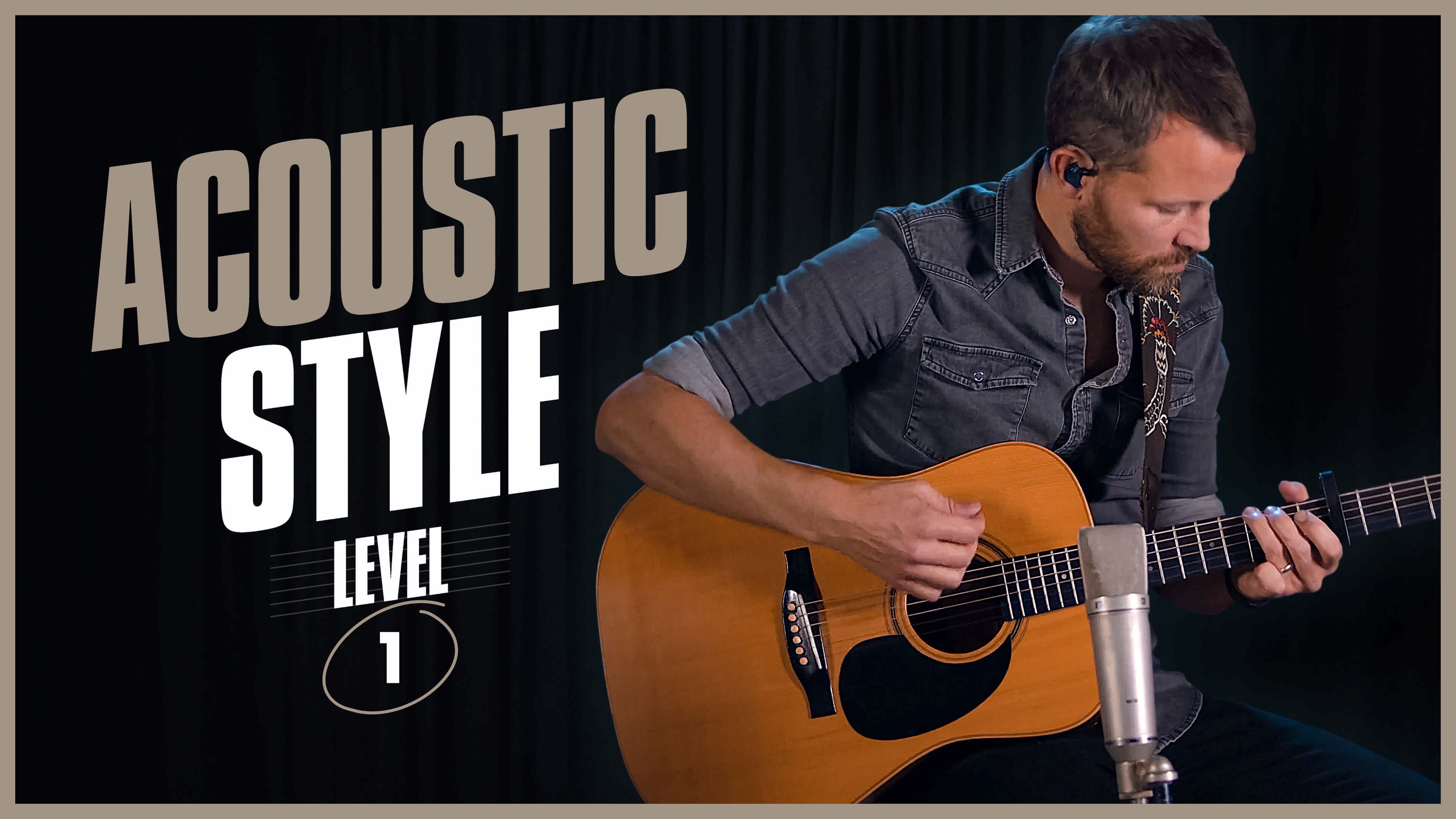
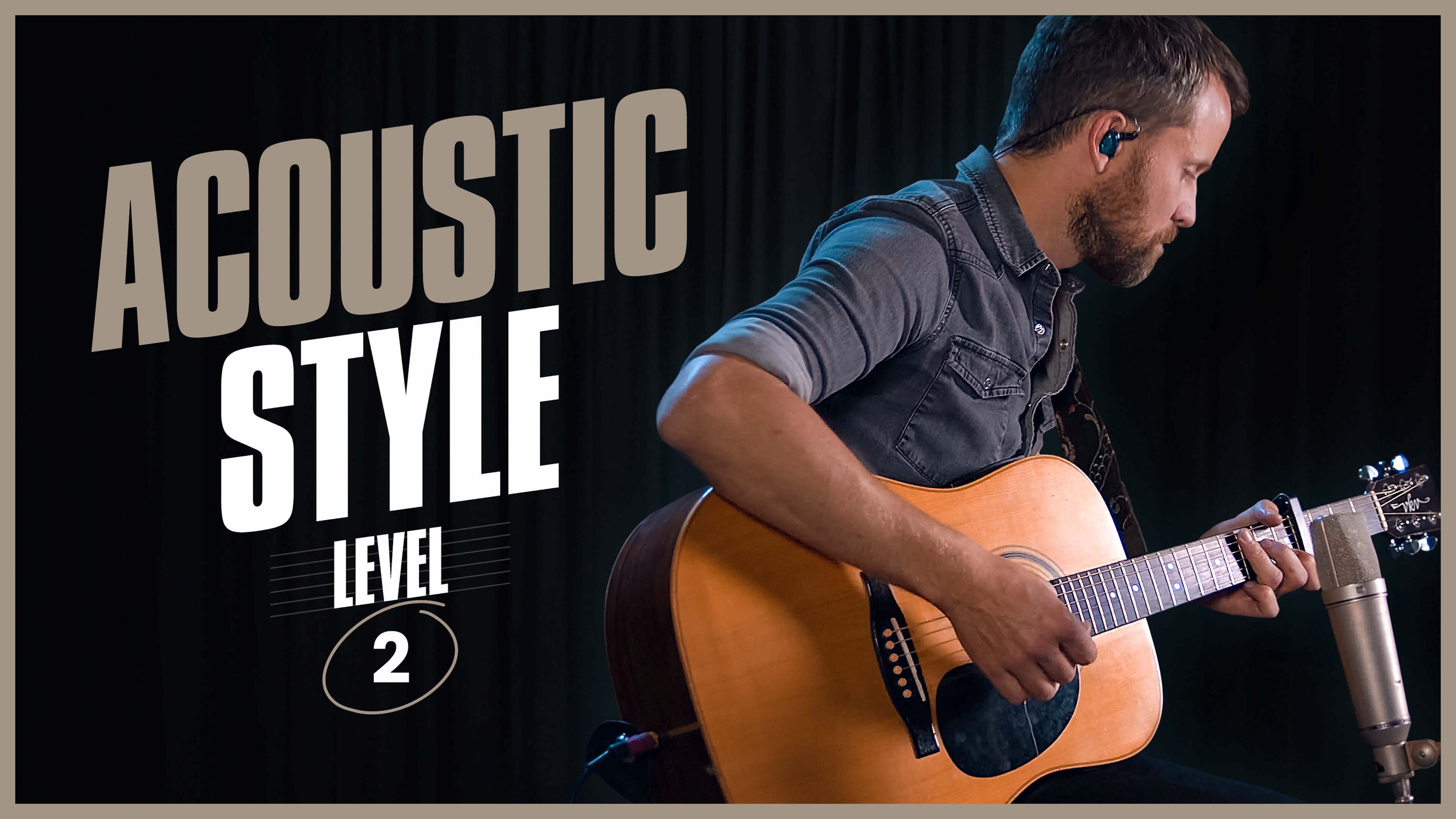
Are you just learning how to play guitar? Check out Acoustic Style Course 1 and Acoustic Style Course 2. In these courses you will be taken step-by-step through every aspect of playing acoustic guitar. Once you make your way through these acoustic guitar lessons, start applying what you’ve learned to some of the best acoustic guitar songs in our acoustic style song library.
Start With Our Beginner Acoustic Course
Top Artists


Beginner Basic Open Chords
Acoustic guitar playing is all about strumming chords. Learn some essential chord groupings in various keys.


In this tutorial we'll practice the open major chords in the key of A: A major, D major and E major. We'll practice playing them in time with a backing track using some basic strumming patterns and various rhythms.

In this tutorial we'll practice the open major chords in the key of E: E major, A major and B major. We'll practice playing them in time using some basic strumming patterns. As usual we'll have a lot of opportunities to play these chord changes along with a backing track to get you ready for real world playing.

In this tutorial we'll practice the open major chords in the key of C: C major, F major and G major. We'll practice playing them in time using some basic strumming patterns. As usual we'll have a lot of opportunities to play these chord changes along with a backing track to get you ready for real world playing.

In this tutorial we'll use 3 open minor chords in the key of A minor: A minor, D minor and E minor. We'll practice playing them in time with a backing track using some basic strumming patterns. We'll use a basic variety of rhythmic subdivisions and strumming patterns.
Beginner Basic Strumming Patterns
Make your chords interesting by using various strumming patterns.

In this tutorial we'll learn a technique called arpeggiation. This is a strumming technique that allows us to play the notes of a chord one at a time, rhythmically separated. This gives us the ability and freedom to create many types of rhythmic and melodic patterns, all from holding one chord. This adds depth and nuance to your playing.

Barrett will show you how to play root chord strumming, which is a common rhythm technique used widely on acoustic guitar in many different styles. It's called root chord strumming because we rhythmically separate the low root note of each chord from the rest of the notes in the chord while we strum. We'll learn root chord strumming with a variety of our most common open major and minor chords. From there we'll apply this technique to a basic practice song set to a backing track. Our main goal here is to master this rhythmic strumming technique so that when used along with our most common open chord shapes we can apply it in many different styles.


In this technique tutorial, Caren Armstrong will get you focused on your strumming. Caren will start by look the right hand with basic 1/8th notes, then she'll spice it up in the next lesson. Caren will explain her concept of "zoning" in the following lesson, and get into some syncopation. Next up is a look at "extreme zoning", then a look at damping (or muting). To finish, Caren will take all the elements and mix them up.


In this tutorial, I'll be showing you how to play a commonly used strumming pattern for acoustic guitar style material. Though any of these principles could be also used in other genres that you've probably heard before. We'll use a group of four chords that are frequently played together in many songs.
Beginner Basic Chord Embellishments (In Key Groups)
Basic open chords can become a bit stale. Learn some easy chord variations to spice up your playing.


In this tutorial we're going to explore some extremely useful open chord embellishments in the key of E. Along with the E major and A major chords, the key of E includes our notorious B barre chord, which is quite challenging for the left hand when you're first starting out. But since the key of E is such a popular guitar key and B is an integral part of that, it shows up all time and is well worth the effort.

In this tutorial we're going to explore some universally useful open chord embellishments in the key of C. The key of C includes the notorious F chord, which is a bit of a beast when you're first starting out. But it's one of those chords that there's no getting around, so in this tutorial you'll get some extra practice time on it as well as some cool variations you can throw in for variation.

In this tutorial we'll explore some universally useful open chord embellishments in the key of A major. These are the kinds of tricks and techniques that most of us use more or less every time we pick up a guitar. We'll explore this within the chord family consisting of A major, D major and E major.

In this tutorial we'll explore some universally useful open chord embellishments in the key of A minor. These are the kinds of tricks and techniques that most of us use more or less every time we pick up a guitar. We'll explore this within the chord family consisting of Am, Dm and Em (the key of A minor).
Beginner Fingerpicking Technique
Fingerstyle guitar is a unique way to play. Get a grasp of fingerpicking in these lessons.


In this tutorial, you're going to learn some basic fingerpicking patterns. We're going to learn two basic right hand picking patterns: thumb 1 2 3, and thumb 2 1 3. And then apply them to a basic three chord progression.

In this tutorial I'll teach you the first level of acoustic fingerpicking. We'll get started with a basic four-step pattern, then learn how to change chords with it. We'll then do some 2 and 3 chord practice drills followed by two songs. Then it's time for drills to build your speed and play another song. Next we'll learn different styles, play another song, and finish with more drills - and a final song!
Fingerpicking guitar isn't just a technique; it's an art form that has been passed down, evolved, and refined through generations of guitarists. This intricate style, where guitarists pluck the strings directly with the fingertips, nails, or picks attached to fingers, creates a uniquely resonant and complex sound that's as captivating as it is expressive. The roots of fingerpicking guitar can be traced back to early stringed instruments and musical traditions from around the world. However, it truly began to flourish in the American South, where it became integral to blues, folk, and country music. Picture this: musicians sitting on porches or around campfires, sharing stories and tunes, their fingers dancing over the guitar strings, weaving together melodies and rhythms that tell tales of life, love, and hardship. If you're eager to dive into this rich tradition, fingerpicking lessons are your gateway to unlocking the magic. Guitar fingerpicking lessons can vary widely, from the basics of plucking patterns to complex melodies that require a dexterous touch and years of practice. What's cool about learning fingerpicking is that it opens up a whole new world of musical possibilities. Unlike strumming, which often focuses on rhythm and harmony, fingerpicking allows you to play the melody, harmony, and rhythm simultaneously, making the guitar sound like an entire band in the hands of a skilled player.

Now that you have mastered the 4-Step Pattern, let's take things to the next level by adding variations of that pattern to create full-measure classic patterns. Along the way, you'll learn to play several classic songs, including Thyme, Blow Ye Winds of the Morning, and Make Me a Pallet on Your Floor. Get ready to ramp things up!

Now that you have mastered the 4-Step Pattern and full measure variations in 4/4 time, let's take a look at new patterns in 3/4 time and 6/8 time. Along the way, you'll learn to play several classic songs, including Star of the County Down, Do You Love an Apple, and a beautiful arrangement of Scarborough Fair with an impressive fancy figure you can play!
Using A Capo
What is a guitar capo? What does a guitar capo do? Learn all about this effective guitar tool.

A capo is a device that is applied to the neck and fretboard of the guitar. It works by applying pressure to the strings and fretting notes wherever we place the capo. Much like a barred index finger does, only the capo replaces the finger. Essentially it is a device that acts just like the nut of the guitar that we can move up and down for a number of helpful reasons.

A capo is a device used to the neck and strings of a guitar that shortens the playable length of the strings & as a result raising the pitch. There are numerous advantages to this result and we'll explore the most important ones in this tutorial.
Intermediate Using Barre Chords On Acoustic
Barre chords can sound big and full when played on an acoustic guitar. Learn how!

In this tutorial, we'll learn some common strumming patterns that will sharpen your rhythm acoustic guitar chops. We'll also get plenty of practice changing chords in time while using our 5th and 6th string root barre chords shapes. We'll finish up with a practice tune that combines everything we've learned. This tutorial uses barre chords, strumming patterns and is played on acoustic guitar.

In this tutorial, we'll explore the fundamental concept of arpeggiation, and how it differs from strumming chords. Learning this technique will add a world of possibilities to your acoustic playing. In the following lessons, we'll review barre chord shapes, learn 1/4 note and 1/8 note arpeggiation examples, and finish up with a practice tune that combines everything we've learned.
Intermediate Picking & Strumming Technique
Take your strumming and chord knowledge to the next level by utilizing basslines.

In this tutorial we'll learn some typical strategies to connect chords with single note lines in the key of E major. Sometimes this is referred to as "walking into or out of" chords. You'll see examples that use and combine 1/4 note and 1/8 note walk ups and walk downs. We'll practice these approaches using the I IV V open chords in the key of E major to create 3 chord progressions, and then finish up with a practice song that combines everything we've learned.

In this tutorial we'll learn some typical strategies to connect chords with single note lines in the key of C major. Sometimes this is referred to as "walking into or out of" chords. You'll see examples that use and combine 1/4 note and 1/8 note walk ups and walk downs. We'll practice these approaches using the I IV V open chords in the key of C major to create 3 chord progressions, and then finish up with a practice song that combines everything we've learned.

In this tutorial we'll learn some typical strategies to connect chords with single note lines in the key of A major. Sometimes this is referred to as "walking into or out of" chords. You'll see examples that use and combine 1/4 note and 1/8 note walk ups and walk downs. We'll practice these approaches using the I IV V open chords in the key of A major to create 3 chord progressions, and then finish up with a practice song that combines everything we've learned.

In this tutorial we'll learn some typical strategies to connect chords with single note lines in the key of A minor. Sometimes this is referred to as "walking into or out of" chords. You'll see examples that use and combine 1/4 note and 1/8 note walk ups and walk downs. We'll practice these approaches using the i-iv-v open chords in the key of A minor to create 3 chord progressions, and then finish up with a practice song that combines everything we've learned.
Intermediate Fingerpicking Technique
Learn new fingerstyle techniques, add some bass-line movement and complete your fingerpicking understanding with a composed song.

The Pinch Pattern uses a pinching motion between your ring finger and your thumb moving together, then the remaining fingers are used to arpeggiate more of the chord. This is the next step in developing your picking hand technique because it's a widely used pattern found in many songs.

In this tutorial, you're going to learn to incorporate bass motion into your fingerstyle playing. In some places we'll use bass notes that aren't the root note of the chord. This opens the door to endless possibilities for your chord progressions, how they move from chord to chord, and also what emotions they evoke.

We're going to cover ascending melodies, descending melodies, and repetitive melodies. We're also going to combine these melodies with the chords/bass movement concepts you just learned. This will all be in the key of C still using the same chords and voicings as before so you don't have to focus on too many new things at once. At the end you're going to use these skills in a song.

In this tutorial we'll craft a song as we learn some new techniques. We'll learn an incredibly important technique called the roll. At the end of this tutorial we're going to put all these elements together and learn a song.

Welcome to Acoustic Fingerpicking, Intermediate Level.
In this set of lessons, we'll build on the skills learned in Acoustic FIngerpicking for Beginners, Levels 1 through 6. We'll take patterns and pattern variations learned in the Beginner section, and begin combining them within a single song. This will allow you to create song arrangements that are more interesting, varied, and dynamic.
Learning to combine patterns leads to refined coordination, and lays the groundwork for adding in some exciting fingerpicking figures, which will be presented in Acoustic Fingerpicking 8, Fingerpicker's Goldmine.

Fingerpicker's Goldmine is a treasure trove of classic fingerpicking figures, perfect for adding flavor and complexity to fingerstyle guitar songs. From Hot Tuna to Jack Johnson, Joni Mitchell to James Taylor, these classic figures have been used extensively by acoustic music's icons. This tutorial is a continuation of the Acoustic Fingerpicking Series, created by Lisa McCormick. All prerequisite skills and concepts necessary to master these figures are taught in earlier lessons in the series.

This tutorial is the graduation ceremony for Acoustic Fingerpicking, Levels 1-8. Learning to play this tune will draw on skills you have learned in the previous levels, and give you a nice instrumental tune for your repertoire.

In this segment, we'll bring all your hard work and solid skills to work in learning to play 3 full songs, complete with fancy ornamentations and arrangements to learn. You'll learn to play The Water is Wide, John Riley, and Lord Franklin's Lament. Prepare to add these beauties to your repertoire.
Acoustic Lead Guitar Technique
Playing lead guitar is a little different than playing lead on electric. We’ll show you what you need to know.

In this tutorial we'll learn some basic skills and ideas to get you playing lead on your acoustic guitar. A quintessential part of playing lead guitar requires the ability to play single note melodies over a chord progression. As usual we'll make a practice tune of the melodies that we learn in order to play along with a backing track so you'll be ready to use these skills and ideas in real world songs.
Alternate Tunings
Alternate tunings are a fun way to open up your options. They can sound especially unique on the acoustic guitar as well. Learn a few here from DADGAD to Double Drop D.

In this tutorial we'll explore one of the simplest and most commonly used examples of an alternate tuning. This tuning is known as "Drop D", and it simply refers to lowering the low E-string by a whole step, down to D, which opens up a world of musical possibilities that we'll explore in this tutorial, within the context of a fun practice tune.

In this tutorial we'll explore a classic alternate tuning known as DADGAD. The reason it's called that is that the open strings are tuned D A D G A D. This is unlike many other open tunings because the open strings aren't tuned to basic major chord, but rather to a tense sus4 chord. The same guiding principle still applies though that we're not gonna try to transfer what we normally play into this new tuning, but rather figure which specific chords, vibes and sounds this tuning is perfect for. Today we'll explore this within the context of a practice tune that I've written specifically to highlight the wondrous beauty of the DADGAD tuning.

In this tutorial we'll explore one of my personal favorite alternate tunings, which is open G. You can do so much cool stuff in this tuning, and I've written a fun practice tune to show you some of my favorite sounds that open G has to offer. Cause as always the idea is not to adapt what we play in standard tuning, but rather to explore what sounds, chords and vibes are comfortably accessible within the open G tuning.

In this tutorial we'll explore a super cool, and yet very simple, alternate tuning known as "Double Drop D". We're only changing two strings from standard tuning, both E strings down a whole step to D. But this will open up a world of cool possibilities. We'll explore all this within the context of a fun practice tune that I've written specifically to show you how cool and accessible the world of "Double Drop D" can be.
Advanced Fingerpicking
Learn some more advanced fingerstyle techniques.

In this tutorial you're going to learn a technique called palm muting for fingerstyle guitar. Palm muting in fingerstyle is used all the time to make the melody stand out more. Muting the bass notes gives you the pitch without the sustain. This allows the upper string melody notes to be heard more clearly. We'll also add syncopation, which is another way of separating the bass notes from the melody.

In this tutorial we're going to cover the topic of hammer-ons and pull-offs in fingerstyle guitar. The hammer-on/pull-off is an essential tool to have in the bag for creating melodies. It creates a note that doesn't have to be played with the right hand. This is great for adding in extra notes, or playing melody notes that otherwise wouldn't be possible. It also adds different sound and can add a variety of articulations to your playing.
Travis Picking Style
Travis Picking is a quintessential fingerpicking pattern used by legendary guitarists. Learn a simplified pattern, then an advanced pattern, plus some additional tips.

In this set of lessons, Caren Armstrong will teach basic Travis picking technique. We'll start with an overview of Travis picking, then get into basic terminology and orientation. Next up is the important hand position, the we'll detail the basic picking pattern and counting the rhythm. A simple exercise follows; then we'll review some reminders of what not to do. Then we'll play some examples in 3 keys, and end with increasing your speed.

Caren will show you to take the basic Travis picking skills learned in an earlier tutorial and play a more advanced version of this this acoustic guitar style technique.

In this tutorial we'll learn the basics of Travis Picking, proper hand position, technique and motor skills for thumbpicking. We'll learn exercises and then compile it all into a mini song at the end.

In this tutorial we're going to continue learning the fundamentals of Travis Picking, this time with a focus on adding different rhythmic concepts. Groove, rhythm and syncopation is an incredibly important part of Travis Picking, so be sure to really focus on your timing and feel throughout this tutorial.

In this tutorial we'll look at how to Travis Pick the blues. This is a super fun and satisfying style to play the blues with. The blues consists of a certain chord structure, I-IV-V in its basic form. It's a fairly simple structure and hundreds of songs are built on this. So we're going to learn a basic blues and also learn ways to spice it up, add some chords, a melody line and put it all together in a performance piece.
Acoustic Special Topics
Below are some specialised topics specific to the acoustic guitar like New-Age style, 12-string techniques and more!

In this tutorial, Anders Mouridsen will teach you ragtime, or country-blues, fingerstyle guitar. Anders will introduce this style and discuss the history a bit, then teach thumb independence. Then it's time to add chords and melodies, after which we'll learn some examples inspired by Blind Blake, Rev. Gary Davis, and Scott Joplin.

In this tutorial I'll show you how much cool stuff you can do with harmonics on the acoustic guitar. We're gonna break down the open harmonics and how to use them to play scales, melodies, and chords. I'll show you how to do the classic "cascading chords" and much more. This is one of those techniques that is nearly impossible to figure out just from listening, but after watching this tutorial you'll know everything you need to go learn some more harmonic tricks on your own!
Acoustic Guitar Maintenance
Understanding basic guitar maintenance will help you understand how to play the instrument. The acoustic guitar can require different approaches than the electric guitar.

In this tutorial we'll get right to the process of changing strings on your acoustic guitar. Specifically, we are changing the strings on a steel string guitar. This process will not apply to a Classical Nylon string guitar which we have a different tutorial for that process. We'll start with your setup and where best to change your strings and also the essential tools you'll need. From there we'll go right into the process and walk through every essential step. Then we'll finish up with some basic reminders and things to keep in mind for the general health of your guitar.

Christopher will show you proper, basic maintenance and how to restring an electric guitar, acoustic guitar and classical nylon string guitar. Keep your machine clean and when it's time for a brand new set of strings, then you'll know how to change them!

Christopher will cover some of the basic of tuning nylon strings if they are new & tips about them if you are new to them!
Practice Advice
Get the most out of your practice with some pro tips from our instructors. Grab a 10 point practice strategy that will ensure you get the most out of your time.

In this set of lessons, Caren Armstrong will delve into the concepts of how to practice. Caren will introduce the tutorial, then get you started on the beginner mindset. Next she'll tune you in to making a beginning with your practice, then how to stay focused. After that we'll talk about how to build muscle memory; then look at how to prioritize your practice, and multi-task. To finish things off, Caren will discuss getting better faster.

Welcome to the Guided Practice Routine for Beginners. Here, you can practice right along with me, and I'll guide you the whole way. This tutorial is divided into 5 stations. For a good well-rounded workout, do the drills that are right for your skill level in each of the 5 stations. Customize your routine to fit your skill level, and the time you have for practicing today. Make this Guided Practice Routine for Beginners a part of your daily guitar playing!

In this tutorial I'll map out a 10 point practice strategy for growing your guitar skills. I'll start by giving you an overview of the entire "map", then the ten point strategy: seeing familiar patterns and repeated elements, planning and economizing finger and hand movement, navigating transitions and maintaining good tone, the role of different notes and chords within a piece, dynamics, and a few tips on maximizing your practice regimen.
Celtic Style Acoustic Instrumentals
Learn a few acoustic songs from the Celtic tradition. This is a nice spin on standard western acoustic guitar playing.

Cil Chais is an ancient melody that comes to us from the hills of Ireland, with all their mist and magic. This relatively uncomplicated acoustic fingerstyle version incorporates melody, bass, and harmony in such a way as to evoke a larger gathering of Irish musicians and instruments. We'll break the piece down and learn it note for note, then play it together all the way through, with a band joining us at the end. Have fun!

In this tutorial, we'll take an overview of the whole tune. We'll talk about working in 6/8 time, and how to count ourselves in to this tune. I'll give you some tips and tricks to make learning and playing the tune easier. and then we'll finish up with 2 playalongs; one at a slowed-down pace, and the other up to speed with a backup band. Have fun!

In this tutorial, we'll take an overview of the whole tune. We'll talk about working in 3/4 time, and how to count ourselves in to this tune. I'll give you some tips and tricks to make learning and playing the tune easier. and then we'll finish up with 2 playalongs; one at a slowed-down pace, and the other up to speed with a backup band. Have fun!

Learn this haunting Celtic tune, played in 9/8 time and DADGAD tuning. Legend has it, this tune is too beautiful and mysterious to have been written by human hands. Its composition is credited to the Faeries of Ireland.


In this tutorial, we'll take a note-for-note look at how to play the beautiful traditional tune, "Oh Danny Boy". We'll look at all the various elements of the song and how to play it fingerstyle on acoustic guitar, and do two play alongs: one in slo-mo and one at tempo. Plus, we'll discuss the underlying principles of practice that will make learning to play this tune much much easier!

This traditional ballad is a lot of fun to learn to play, with a great little acoustic melody solo and upbeat strumming technique. The story is great too. They really had it out for this poor guy, John Barleycorn. Have fun with this one!
Essential Acoustic Songs
Apply what you've learned so far to some songs hand selected especially for this course.


You may not recognize the song title, but no doubt you've heard this song many times on the radio in the last few years and are familiar with it! This is a great song for learning your acoustic fingerpicking technique. We'll take a look at the verse and chorus, the bridge, and play through the whole song at the end in a play a long with some vocals marking the tune. Have fun!


In this song tutorial I'll teach you how to play the song She Talks To Angels as made famous by The Black Crowes. This song is played in an open E tuning and is a great song to play on acoustic guitar. We're gonna break down every note that is played on this recording - everything from the classic intro to the verses and choruses, and the form of the song - so that next time you pick up an acoustic guitar you'll be able to play this beautiful, soulful tune.


Learn the Imagine chords as it has been arranged to be played on an acoustic guitar. Caren will show you how to strum the chord progression as well as the finger picking pattern. There's also a bonus lesson focused on the famous piano motif. Learn John Lennon's classic song along with a backing track and even sing along with the Imagine lyrics.


In this tutorial we are going to learn how to play "Dust in the Wind" as made famous by Kansas. We'll focus on the musical elements that have made this song a long standing classic, by way of teaching you the acclaimed acoustic guitar parts and violin solo. We will break down the tutorial into 5 video lessons.


Here Comes the Sun chords and tabs in this lesson will be taught with a capo on an acoustic guitar. Mike will show you how to play the strumming melodies and chords throughout the arrangement. There's straight ahead verse and chorus sections that features a specific picking pattern that make them uniquely identifiable. There's also a bridge that builds the dynamic with a contrasting time signature and arpeggiated feel. Learn all of this with Here Comes the Sun lyrics so you can sing and play at the same time.


Mike will show you how to play a made easy version of this tune using simple strumming patterns, open chords and barre chords, and dynamics.

Mike will show you all the parts to this classic rock ballad based on R&B and country ideas. There are steady acoustic strumming, dynamics and harmonics, as well as some country-influenced lead techniques using a combination of acoustic and electric guitars.


In this tutorial, Caren Armstrong will teach "Who Will Save Your Soul', as made famous by Jewel. After a song introduction and a brief look at the acoustic tone, Caren will go over the chords used in the song. Next up is the right hand picking, and the song form. We'll learn the song intro part next, then the verse and chorus sections; the "breakdown" follows that, then the ending. We conclude with a play along performance then a jam along.

This tutorial is a made easy version of the iconic Beatles tune arranged for acoustic guitar. This song uses open chords, a simple strum pattern, and dynamics.

This song has one acoustic guitar part, but any guitar is suitable to play it. If you have an electric guitar, just play with a clean tone. This song uses fingerpicking, open chords, higher chord voicings and an open pedal note.


In this tutorial, Caren Armstrong will teach "Kiss From A Rose", as made famous by Seal. Caren will introduce the song, then go over the "big picture" fundamentals you should know: the key, the chords, the strum, the finger picking, and the song form. Then it's on to the verses and the variations in each. You'll learn the chorus next, then the transition, the bridge, and the song ending. We'll end with a play along performance and a jam along.

Any acoustic guitar can be used to play this song. Be sure to place a capo at the 2nd fret to play along with this tutorial. This song uses single note melodies with chord strums, a 6/8 groove, and some melodic single note lines.


Douglas will show you how to play this beautiful acoustic track with a great groove, and an easy chord progression that is fun to play and features Taylor's signature finger picking.


Get your love beads on and learn to play this fun and easy classic. We opted for a simple approach to this song, so we'll be delving into a solo guitar version by Janis Joplin. We'll look at the chords, strumming patterns, and guitar work...and we'll also look at the overall song structure, and what it is that makes this "cinematic" country song "tick".


In this tutorial, Tom Finch will teach "Ventura Highway", by America. Tom will introduce the song and talk about the acoustic tone, then break down the iconic melody and chords in the intro. We'll break down the verse chords and melody next before heading to the chorus. You'll learn the post-chorus next, then the outro; then we'll do full and single guitar performances and end with a jam along.

In this set of eight lessons, Douglas Showalter will take you through the acoustic folk classic "Cat's in the Cradle", recorded by Harry Chapin. Douglas will how you how to play the main riff with a capo at the 8th fret, and rest at the first fret. He'll take you through the signature riff, then the verse, pre-chorus, and chorus parts. Then you'll learn the bridge of the song, and the ending; then we'll play through the entire song.


Lisa McCormick teaches you two complete versions of this song in this tutorial; one of these is played in an acoustic-rock strumming style, and the other is a fairly advanced fingerstyle version. At the end of the tutorial, there is a full-band playthrough, with no guitar in the mix. Why? That's your job! Learn the strumming version, or the fingerstyle version, or make up your own hybrid version and rock out with the band.

Dave will show you the single acoustic guitar part in this classic 60 pop rock song. The part features delicately finger-picked chords, melodies, and bass notes. This song is in the key of E minor and 4/4 time at a tempo of 110 BPM.
Acoustic Artist Studies
Learn how to play acoustic guitar like the legends themselves.

In this tutorial we'll explore some signature elements of acoustic guitar player James Taylor. We'll learn a practice tune that pays tribute to all the best tricks and techniques, and as always we'll go through it all section by section, exploring powerful hammer-on and pull-off tricks, interesting harmony, finger picking, strumming and much more.


In this tutorial we'll be covering topics ranging from moving chord shapes, to hammer-ons, to right hand strumming techniques. Each lesson will help showcase a different aspect of Jack Johnson's style, and will help you learn how using the acoustic guitar primarily as a songwriting tool can serve to better any player's approach to the instrument.

Focusing on Mayer's style on acoustic guitar, this tutorial provides 10 examples, all of which showcase a different element of his style on guitar. Â By the end of these lessons, you should have a greater insight into using percussive techniques, dropped tunings, and interesting chord voicings - and be able to see how you can introduce these elements into your own playing. Â
FAQ
Can I teach myself acoustic guitar?
Absolutely, you can teach yourself acoustic guitar! Many resources are available like online guitar lessons. The key is consistent practice and patience.
Can a beginner play acoustic guitar?
Yes, a beginner can definitely start with an acoustic guitar. In fact, it's often recommended for beginners because it helps develop finger strength and dexterity.
What are the 4 basic acoustic guitar chords?
The four basic acoustic guitar chords are C Major, G Major, D Major, and A Major. These are fundamental chords that are used in a wide variety of songs.
How should I start learning acoustic guitar?
Start by familiarizing yourself with the guitar parts, learning how to hold the guitar and pick, and practicing finger placement. Then, move on to learning the basic chords and strumming patterns. It's also helpful to start with simple songs to build up your skills.
What is the 3 to 1 rule acoustic guitar?
The 3 to 1 rule in acoustic guitar playing suggests that you should spend three times as much practicing chord transitions as you do learning the chords themselves. This helps in smoothing out your playing and making it sound more fluid.
How long does it take the average person to learn acoustic guitar?
Many people can play basic songs within a few weeks or even days of regular practice. Proficiency can take anywhere from a year to several years, depending on how much time and effort you put in and what your goals are.
Which is easier, guitar or piano?
Generally people find the basics of guitar easier to pick up because the concepts are much more simple. For example, once you know three chords, you can play hundreds of easy guitar songs.
Can you get good at guitar in a year?
Yes, with practice you can definitely become quite good at guitar within a year. Consistency is key here, because you’ll need to devote daily time for practicing to improve.
Can I learn guitar at 60?
Absolutely! You can learn guitar at any age. While younger people might find it easier to learn certain physical aspects, older individuals often have better discipline and patience, which are crucial for learning an instrument.
What is the best way for an older person to learn guitar?
Older learners might benefit from starting with lighter strings and an easy-to-play guitar to minimize discomfort. Taking things at a comfortable pace, setting realistic goals, and possibly taking guitar lessons online will help make the learning process smoother and more enjoyable.
Need Extra Help with your playing?
Book A Private Lesson
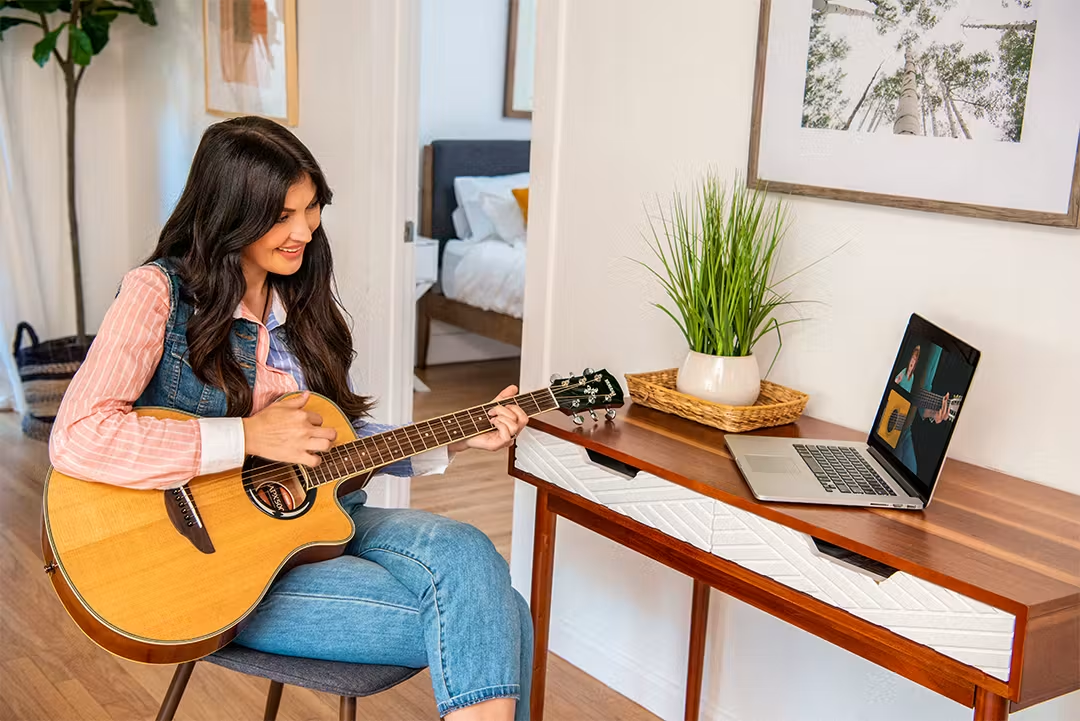
Schedule a 30 or 60 minute lesson with a coach who can offer advice and guidance to improve your playing.

Request A Custom Lesson Plan
Whether you’re just starting to play or returning from a long break, a guided practice plan can get you to where you want to be sooner.